This site documents GEMC version 3 and later. For CLAS12 simulations, use the GEMC2 clas12Tags repository.
Database-driven Geant4 simulations with a Python API
GEMC is a Python-friendly wrapper around Geant4 that eliminates the C++/Geant4 learning curve. Users build complete detector systems in Python: geometry, materials, and digitization. The API automatically populates the databases that GEMC uses to run the full simulation pipeline.
Highlights:
- Python API to create geometry and materials
- Geometry imports from ASCII, SQLite, GDML, and CAD mesh files
- Built-in sensitive detectors: flux, dosimeter, particle_counter, and gPhotonDetector
- Output formats: ASCII, CSV, JSON, and ROOT
- Built-in Python
analyzermodule for reading and plotting simulation output pyvistageometry visualization- Geometry variations and run-number-dependent configurations
- CI-tested builds and Docker deployment
Try GEMC
No installation needed. Click a badge to launch a live JupyterLab session in your browser:

|
Creates a system with a simple detector and a target |

|
Reproduces the Geant4 basic B2 example |

|
Imports STL organ meshes with the CAD factory and records dose per organ |
|
|
11 verified vertex and angular cases with Analyzer plots |

|
Builds subtraction, union, and intersection solids from reusable component volumes |

|
Demonstrates Geant4 built-in materials, custom compositions, and optical properties |

|
48 trapezoidal scintillator paddles tiling a cylindrical barrel using distribute_on_circle |

|
Showcases the activation of the Cherenkov radiation in a GEMC detector |

|
Showcases polished, rough, and semi-transparent optical mirrors under identical conditions |

|
Focus optical photons with a thin G4Paraboloid mirror shell |
Container image
For a local or HPC JupyterLab session, use the prebuilt multi-architecture image:
# Docker
docker run --rm -p 8888:8888 ghcr.io/gemc/binder-tutorials:latest

# Apptainer
apptainer pull gemc-binder-tutorials.sif docker://ghcr.io/gemc/binder-tutorials:latest
apptainer exec gemc-binder-tutorials.sif jupyter lab --ip=0.0.0.0 --no-browser
Interactive 3D Gallery
Rotate the camera with the mouse wheel or use the arrow keys within each thumbnail. Click on the title link for the documentation.
geant4 basic/b2
CAD
Generator Manipulations
Boolean Solids
Materials
Scintillator Barrel
Cherenkov
Mirrors
Parabolic Mirror
DC
EC
PCAL
FTOF
LTCC
HTCC
FT
pygemc: the Python API
The GEMC Python API, pygemc, provides geometry and material database builders, pyvista geometry visualization,
gemc-system-template, and gemc-analyzer. The analyzer can read GEMC CSV and ROOT output and plot
histograms from selected variables.
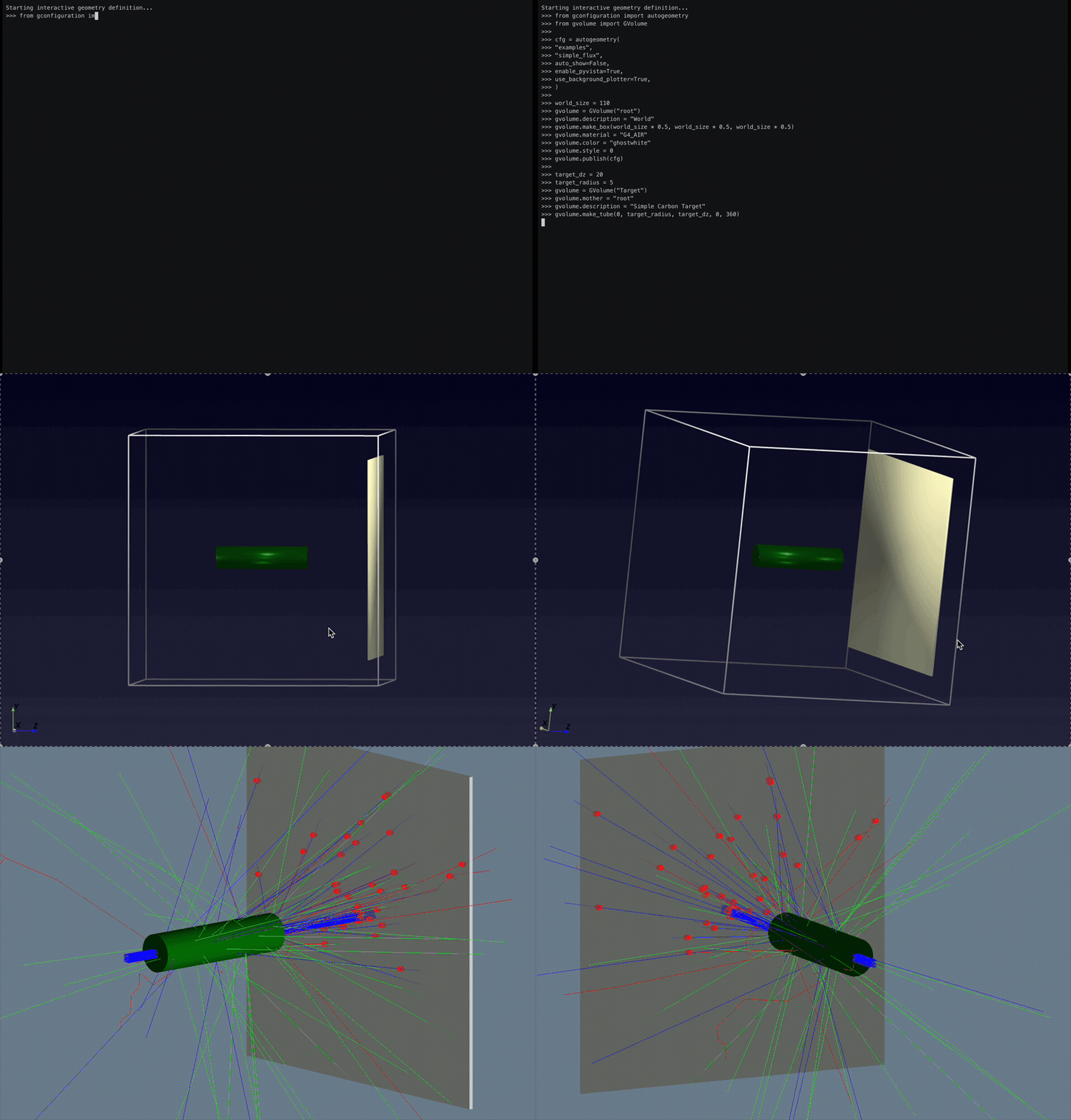
The `pyvista` option gives immediate geometry visualization.
In the GEMC simulation, hits are created from particles generated by a beam of protons impinging on the liquid hydrogen target.
The total deposited energy is plotted with the `analyzer` module.
The excerpt below defines the sensitive flux plane downstream of the target. GEMC records a flux hit each time a generated track crosses this volume.
# Place a thin scoring plane downstream of the target.
flux_z = 50
flux_dx = 1
flux_dim = world_size * 0.8

# Define the plane as an air box inside the world volume.
gvolume = GVolume("FluxPlane")
gvolume.mother = "root"
gvolume.description = "Flux Scoring Plane"
gvolume.make_box(flux_dim * 0.5, flux_dim * 0.5, flux_dx * 0.5)
gvolume.material = "G4_AIR"
gvolume.color = "FAFAD2"
gvolume.set_position(0, 0, flux_z)

# Turn the volume into a GEMC flux detector and tag its output column.
gvolume.digitization = "flux"
gvolume.set_identifier("flux_plane", 1)
gvolume.publish(cfg)
Databases
Detector definitions are stored in databases. A typical workflow has one user-authored step:
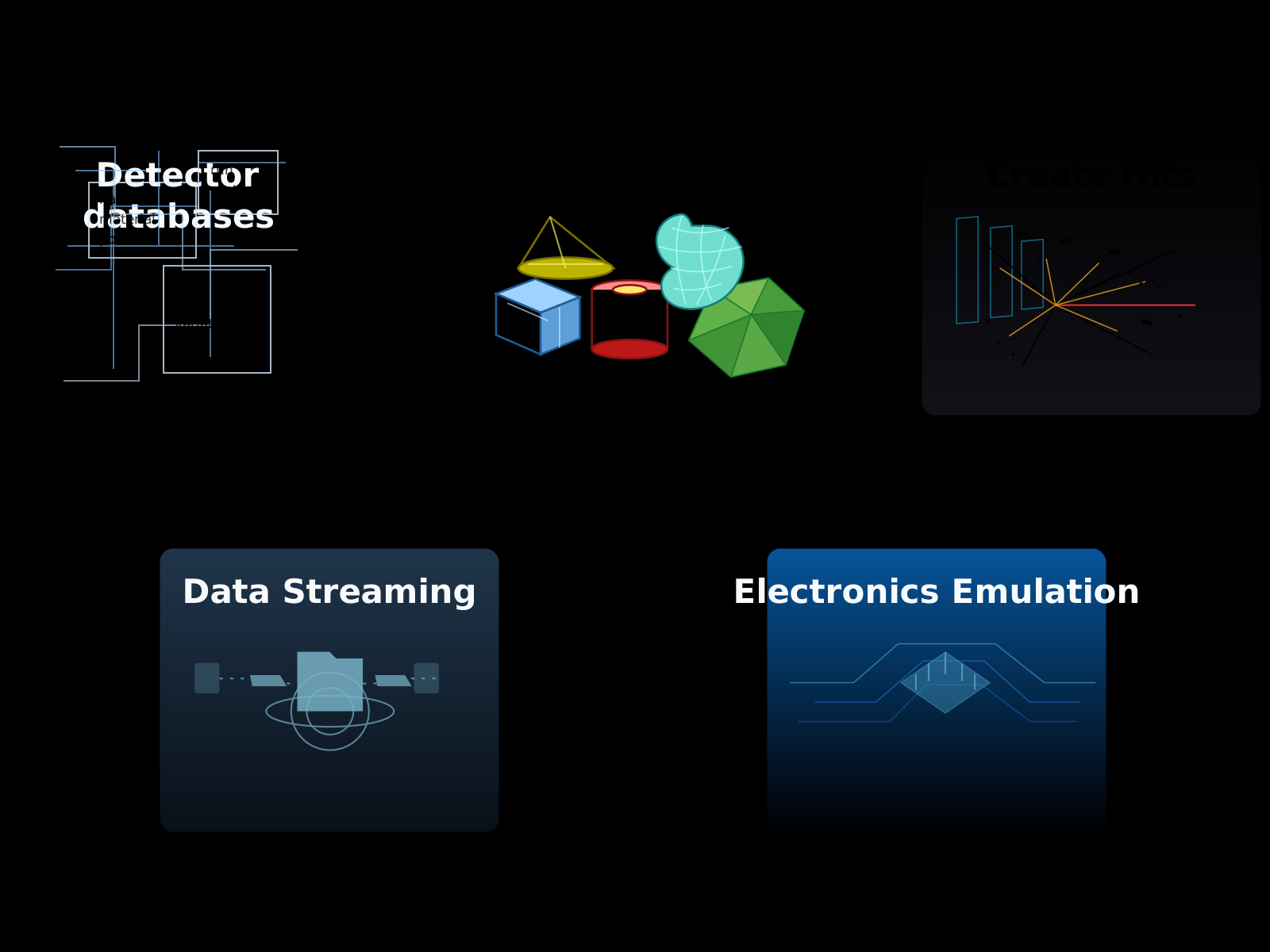
Note
Running simulations does not require previous knowledge of C++ or Geant4. Basic Python knowledge helps organize complex setups. Users can also define their own hardware emulation routines. In this case, basic C++ knowledge helps for complex digitizations.
Geometry Variations
A detector can be reused across experiments, with configuration changes such as component shifts, material changes, or volume additions and removals. GEMC supports these geometry versions using variation strings and/or run numbers to adapt to different simulation setups.
Latest News
Roadmap to GEMC 0.6
This roadmap tracks the new features, improvements, and issue resolutions planned for GEMC 0.6.
GEMC 0.5
GEMC 0.5 adds streaming readout, Geant4 macro execution, and more reliable geometry and multithreaded simulation. The coordinated release also includes pygemc 0.5.0 and CLAS12 systems 0.3.
Roadmap to GEMC 0.5
This roadmap tracks the new features, improvements, and issue resolutions planned for GEMC 0.5.
Continuous Integration
GEMC is built, tested, and deployed as Docker images by GitHub CI on several platforms and on both ARM64 and AMD64 architectures.
gemc
| Tests |  |
| Sanitizer |  |
| CodeQL |  |
| Image Deploy |  |
| Binary Tarballs |  |
| macOS Tarball |  |
| Nightly Release |  |
| Homepage |  |
| Docker Pulls |  |
| Doxygen |  |
| Release Tarballs |  |
pygemc
| Nightly Dev Release |  |
| Publish to PyPI |  |
| Tests |  |
| PyPI |  |
Reference
Please make sure to cite the following paper if you use GEMC:
M. Ungaro and the CLAS Collaboration, “The CLAS12 Geant4 simulation,” Nuclear Instruments and Methods in Physics Research Section A: Accelerators, Spectrometers, Detectors and Associated Equipment 959, 163422 (2020). https://doi.org/10.1016/j.nima.2020.163422
BibTeX:
@article{UNGARO2020163422,
  title = {The CLAS12 Geant4 simulation},
  journal = {Nuclear Instruments and Methods in Physics Research Section A: Accelerators,
             Spectrometers, Detectors and Associated Equipment},
  volume = {959},
  pages = {163422},
  year = {2020},
  issn = {0168-9002},
  doi = {https://doi.org/10.1016/j.nima.2020.163422},
  url = {https://www.sciencedirect.com/science/article/pii/S0168900220300279},
  author = {M. Ungaro and {CLAS Collaboration}},
  keywords = {Geant4, GEMC, Simulation, Software, Database, Monte Carlo, CAD, STL, GDML, MYSQL, C++}
}
Bibitem:
\bibitem{UNGARO2020163422}
M. Ungaro and the CLAS Collaboration,
\newblock The CLAS12 Geant4 simulation.
\newblock Nuclear Instruments and Methods in Physics Research Section A \textbf{959}, 163422 (2020).
\newblock \doi{10.1016/j.nima.2020.163422}
Source Code and License
The GEMC source code is licensed under the Apache License, Version 2.0; see NOTICE for attribution and third-party acknowledgments. The software also depends on separately licensed third-party components, including Geant4, CLHEP, Qt, ROOT, SQLite, and Assimp.