Internal Generator
The internal GEMC generator is configured with two cumulative options.
gparticle defines inline particle sources. Each entry adds one particle (or a group of identical copies) to every event. Multiple entries can be combined in the same list.
gparticlefile loads event records from a file. The built-in reader supports the LUND format.
When both options are present, every generated event receives all particles from gparticle plus all particles from the matching event record in each gparticlefile source.
Both options can be set from the YAML steering card or the command line:
# YAML steering card
gparticle:
  - name: e-
    p: 2300*MeV
    theta: 23*deg
# equivalent command-line form
gemc -gparticle="[{name: e-, p: 2300*MeV, theta: 23*deg}]"
gparticle
Unit convention
All kinematic values accept an explicit Geant4 unit attached with *, for example
4*GeV, 23*deg, 0.4*rad, -10*cm, 1.5*mm. This is the recommended form.
If a plain number without a unit is given, GEMC falls back to the field default and logs a warning:
| Field group | Default unit |
|---|---|
Momentum (p, delta_p) |
MeV |
Angles (theta, delta_theta, phi, delta_phi) |
deg |
Vertex (vx, vy, vz, delta_vx, delta_vy, delta_vz) |
cm |
Fields
name and p are required. All other fields are optional.
| Field | Default | Description |
|---|---|---|
| name | required | Geant4 particle name, e.g. e-, proton, gamma, pi+ |
| p | required | Nominal momentum magnitude with unit, e.g. 4*GeV or 4000*MeV |
| multiplicity | 1 | Number of copies generated per event; each copy is independently randomized |
| delta_p | 0*MeV | Momentum spread around p |
| randomMomentumModel | uniform | uniform: flat in [p - delta_p, p + delta_p]; gaussian: Gaussian with sigma delta_p |
| theta | 0*deg | Nominal polar angle (from the z-axis), e.g. 23*deg or 0.4*rad |
| delta_theta | 0*deg | Polar-angle spread around theta |
| randomThetaModel | uniform | uniform: flat in [theta - delta_theta, theta + delta_theta]; gaussian: Gaussian sigma delta_theta; cosine: cos(theta) uniform, with rejection sampling within the window (see note below) |
| phi | 0*deg | Nominal azimuthal angle |
| delta_phi | 0*deg | Azimuthal-angle spread. Always applied with the uniform model; there is no randomPhiModel |
| vx | 0*cm | Nominal vertex x |
| vy | 0*cm | Nominal vertex y |
| vz | 0*cm | Nominal vertex z |
| delta_vx | 0*cm | Vertex x spread |
| delta_vy | 0*cm | Vertex y spread |
| delta_vz | 0*cm | Vertex z spread |
| randomVertexModel | uniform | uniform: each component flat in [v - delta_v, v + delta_v]; gaussian: Gaussian sigma per component; sphere: uniform sampling within a spherical volume (see note below) |
Note
cosine theta model: samples theta such that cos(theta) is uniform using rejection sampling within [theta - delta_theta, theta + delta_theta]. For narrow windows the acceptance rate can be low. This model is most efficient when delta_theta covers a large fraction of the full range [0, 180 deg].
Note
sphere vertex model: generates vertices uniformly within a spherical volume centered on the nominal vertex. Set delta_vx, delta_vy, and delta_vz all equal to the desired sphere radius. Using different values for the three components changes the effective sampling sphere size.
Examples
The generator manipulation examples provide separate YAML cards for vertex and angular sampling, with 100-event GEMC views and verified Analyzer plots. Particles originate inside a transparent tube target; Z smearing uses theta = 90 degrees and XY smearing uses theta = 45 degrees.
One 2.3 GeV electron at 23°
gparticle:
  - name: e-
    p: 2.3*GeV
    theta: 23*deg
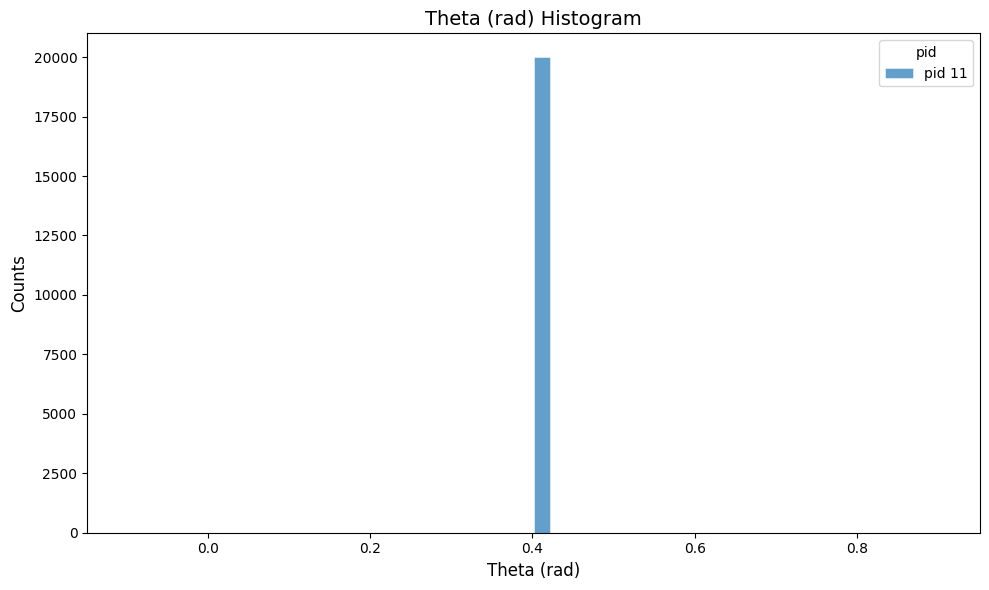
Analyzer command:
gemc-analyzer generated_tracked.csv theta --kind csv --bins 50 --linear-y
Theta spread of 0.2 rad
gparticle:
  - name: e-
    p: 2.3*GeV
    theta: 0.4*rad
    delta_theta: 0.2*rad
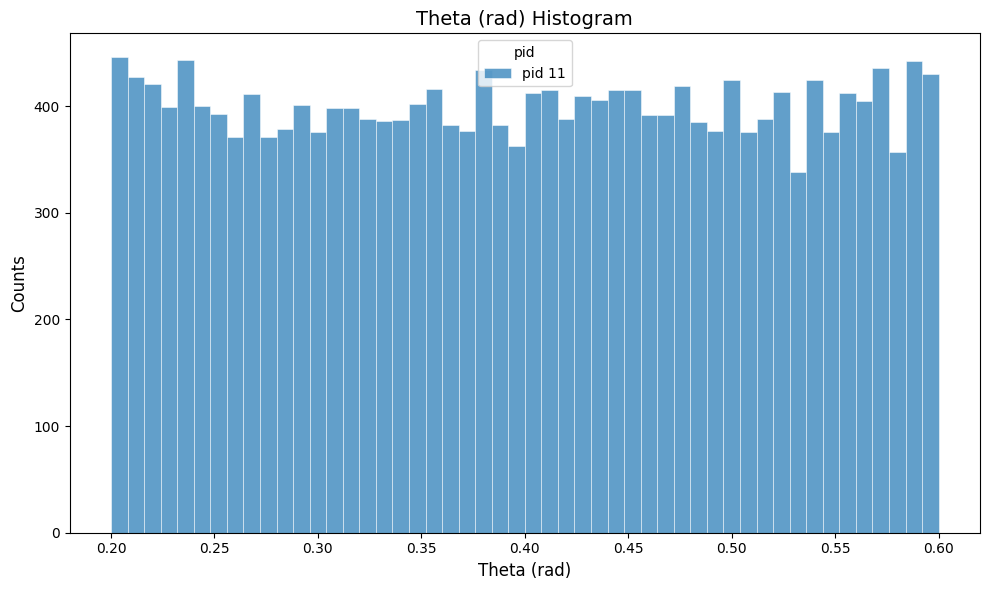
Analyzer command:
gemc-analyzer generated_tracked.csv theta --kind csv --bins 50 --linear-y
10 protons per event, uniform in φ
gparticle:
  - name: proton
    multiplicity: 10
    p: 1200*MeV
    theta: 14*deg
    delta_phi: 180*deg
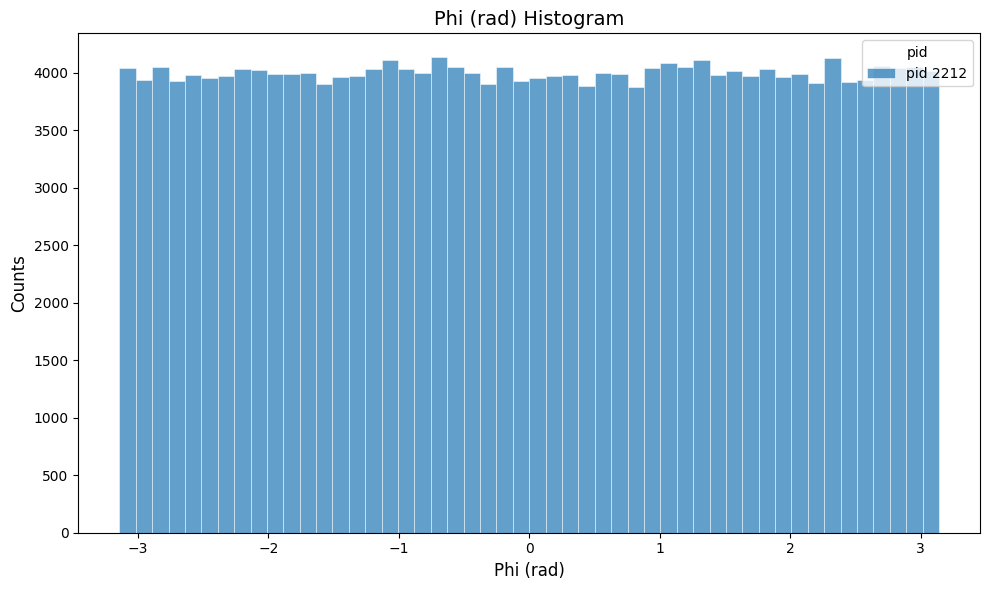
Analyzer command:
gemc-analyzer generated_tracked.csv phi --kind csv --bins 50 --linear-y
Momentum spread — uniform
gparticle:
  - name: e-
    p: 2300*MeV
    delta_p: 100*MeV
    randomMomentumModel: uniform
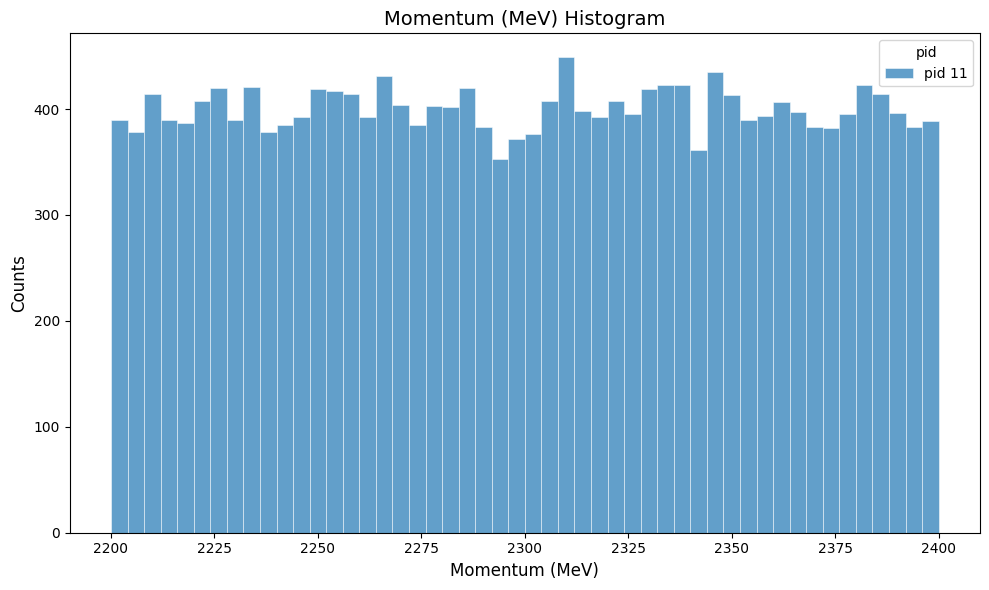
Analyzer command:
gemc-analyzer generated_tracked.csv p --kind csv --bins 50 --linear-y
Momentum spread — Gaussian
gparticle:
  - name: e-
    p: 2300*MeV
    delta_p: 100*MeV
    randomMomentumModel: gaussian
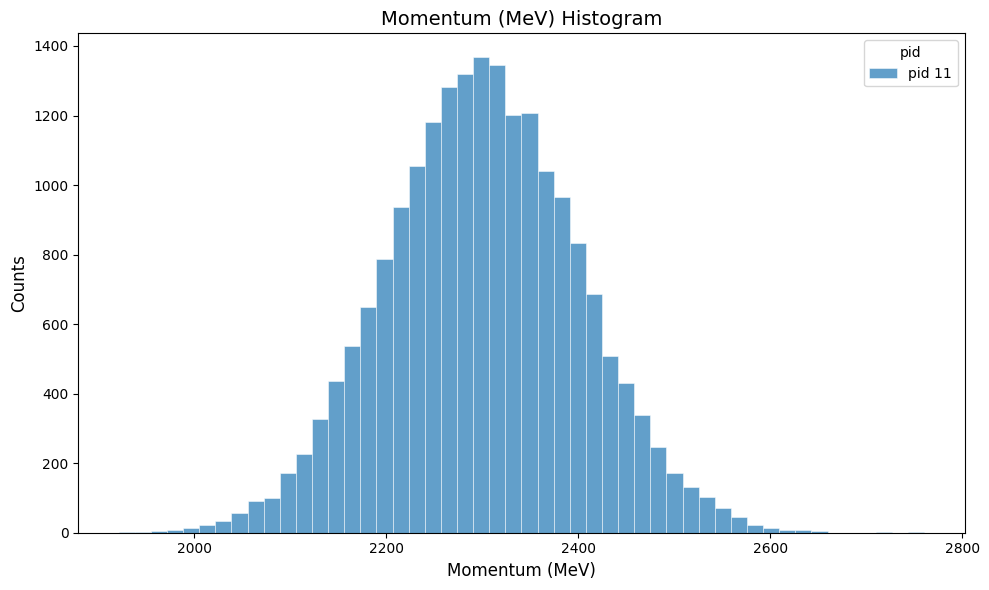
Analyzer command:
gemc-analyzer generated_tracked.csv p --kind csv --bins 50 --linear-y
Cosine theta sampling
gparticle:
  - name: e-
    p: 2300*MeV
    theta: 23*deg
    delta_theta: 5*deg
    randomThetaModel: cosine
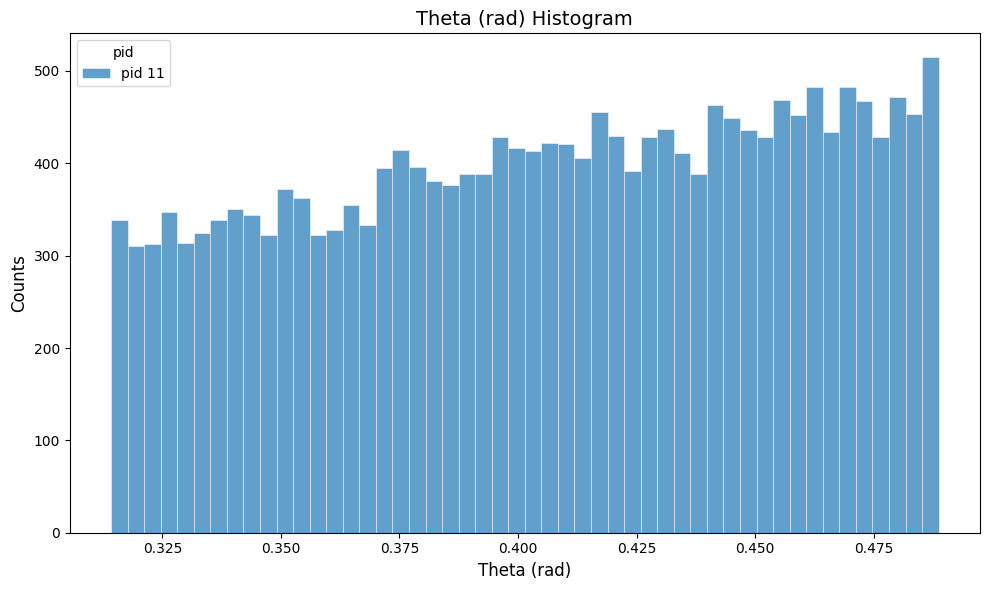
Analyzer command:
gemc-analyzer generated_tracked.csv theta --kind csv --bins 50 --linear-y
Azimuthal-angle spread
gparticle:
  - name: e-
    p: 2300*MeV
    phi: 45*deg
    delta_phi: 20*deg
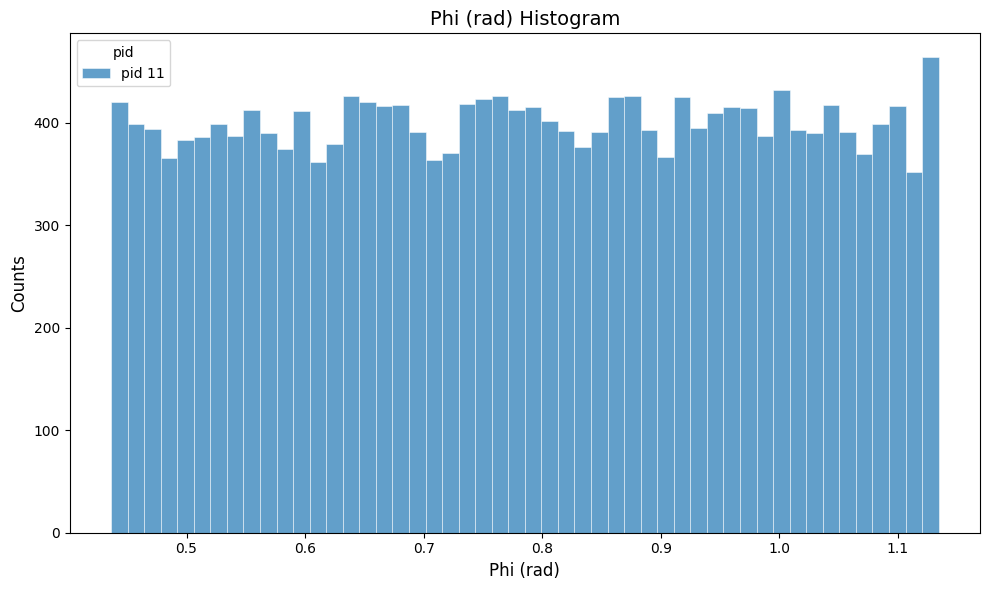
Analyzer command:
gemc-analyzer generated_tracked.csv phi --kind csv --bins 50 --linear-y
Fixed vertex position
gparticle:
  - name: e-
    p: 2300*MeV
    vx: 0*cm
    vy: 0*cm
    vz: -10*cm
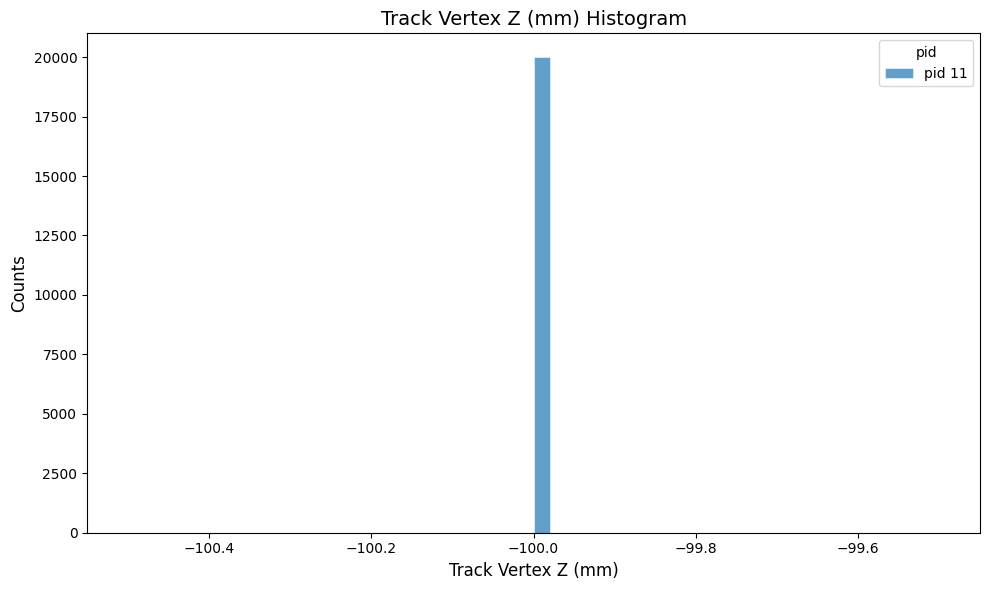
Analyzer command:
gemc-analyzer generated_tracked.csv vz --kind csv --bins 50 --linear-y
Vertex z spread — uniform
gparticle:
  - name: e-
    p: 2300*MeV
    vz: 0*cm
    delta_vz: 2*cm
    randomVertexModel: uniform
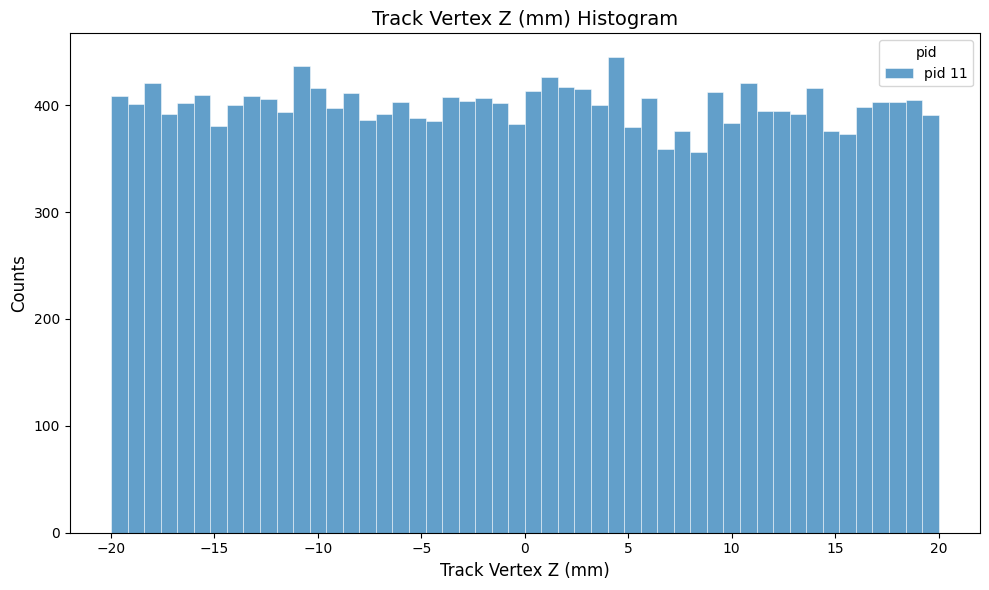
Analyzer command:
gemc-analyzer generated_tracked.csv vz --kind csv --bins 50 --linear-y
Vertex spread — Gaussian
gparticle:
  - name: e-
    p: 2300*MeV
    delta_vx: 1*mm
    delta_vy: 1*mm
    delta_vz: 5*mm
    randomVertexModel: gaussian
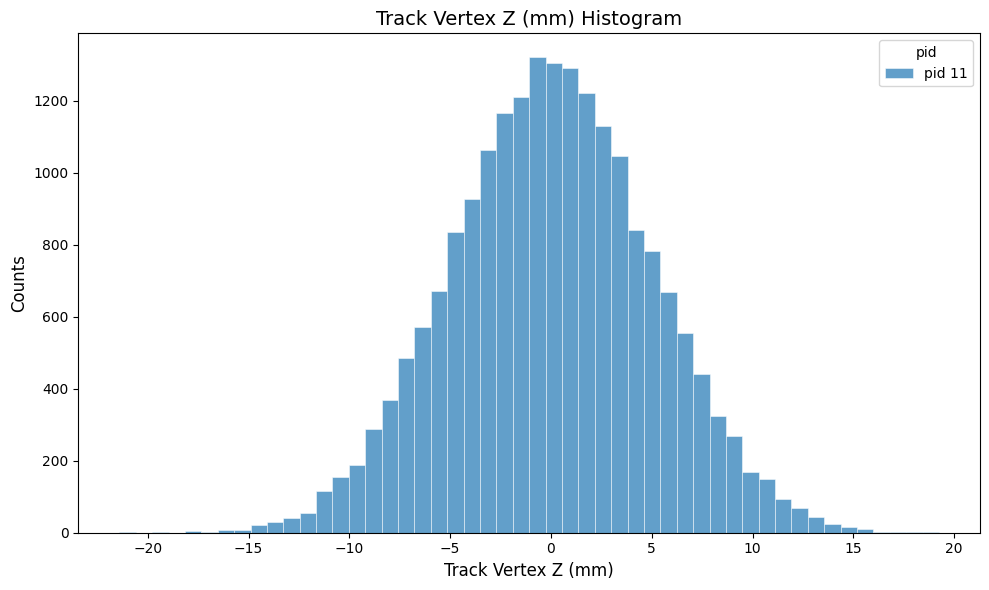
Analyzer command:
gemc-analyzer generated_tracked.csv vz --kind csv --bins 50 --linear-y
Multiple particle definitions
Each entry is an independent source; all contribute to every event. Here one electron (fixed angle) and two protons (smeared angle) are generated per event:
gparticle:
  - name: e-
    p: 2300*MeV
    theta: 23*deg
  - name: proton
    multiplicity: 2
    p: 1200*MeV
    theta: 14*deg
    delta_theta: 10*deg
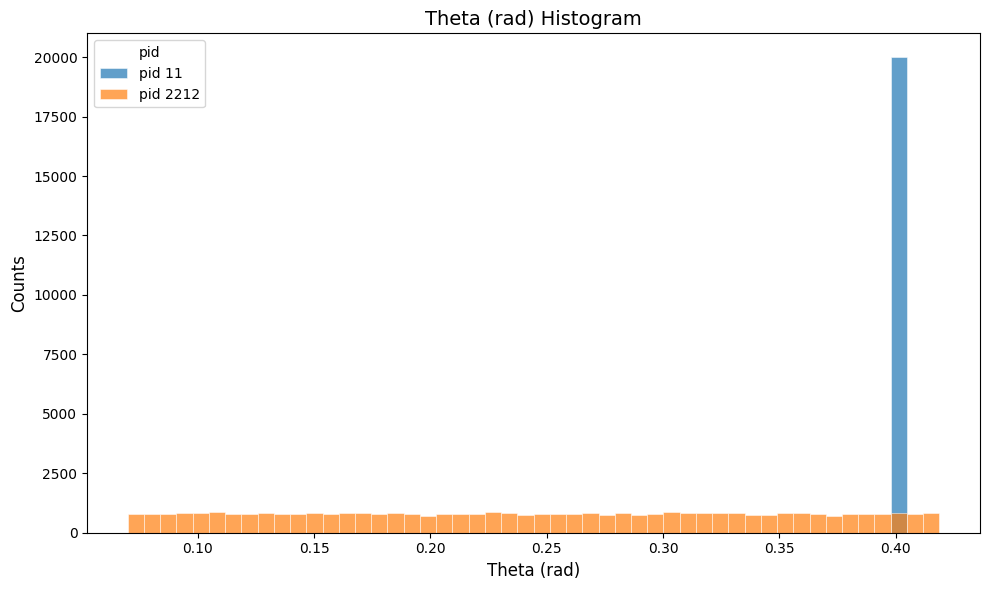
Analyzer command:
gemc-analyzer generated_tracked.csv theta --kind csv --bins 50 --linear-y
gparticlefile
gparticlefile loads particle definitions from a file. Each entry specifies a format
and a filename:
| Field | Description |
|---|---|
format |
File format reader name. The built-in reader is lund (case-insensitive). |
filename |
Path to the input file containing event records. |
gparticlefile:
  - format: lund
    filename: events.lund
Event records are matched by index: file event 0 is used for GEMC event 0, file event 1 for GEMC event 1, and so on. In multi-threaded mode Geant4 distributes event IDs to worker threads; each file event is still assigned to exactly one GEMC event.
Multiple sources can be combined — events from all files are merged by index:
gparticlefile:
  - format: lund
    filename: beam_background.lund
  - format: lund
    filename: signal.lund
See the LUND format documentation for the file structure, column definitions, and unit conventions.