Mirrors Example
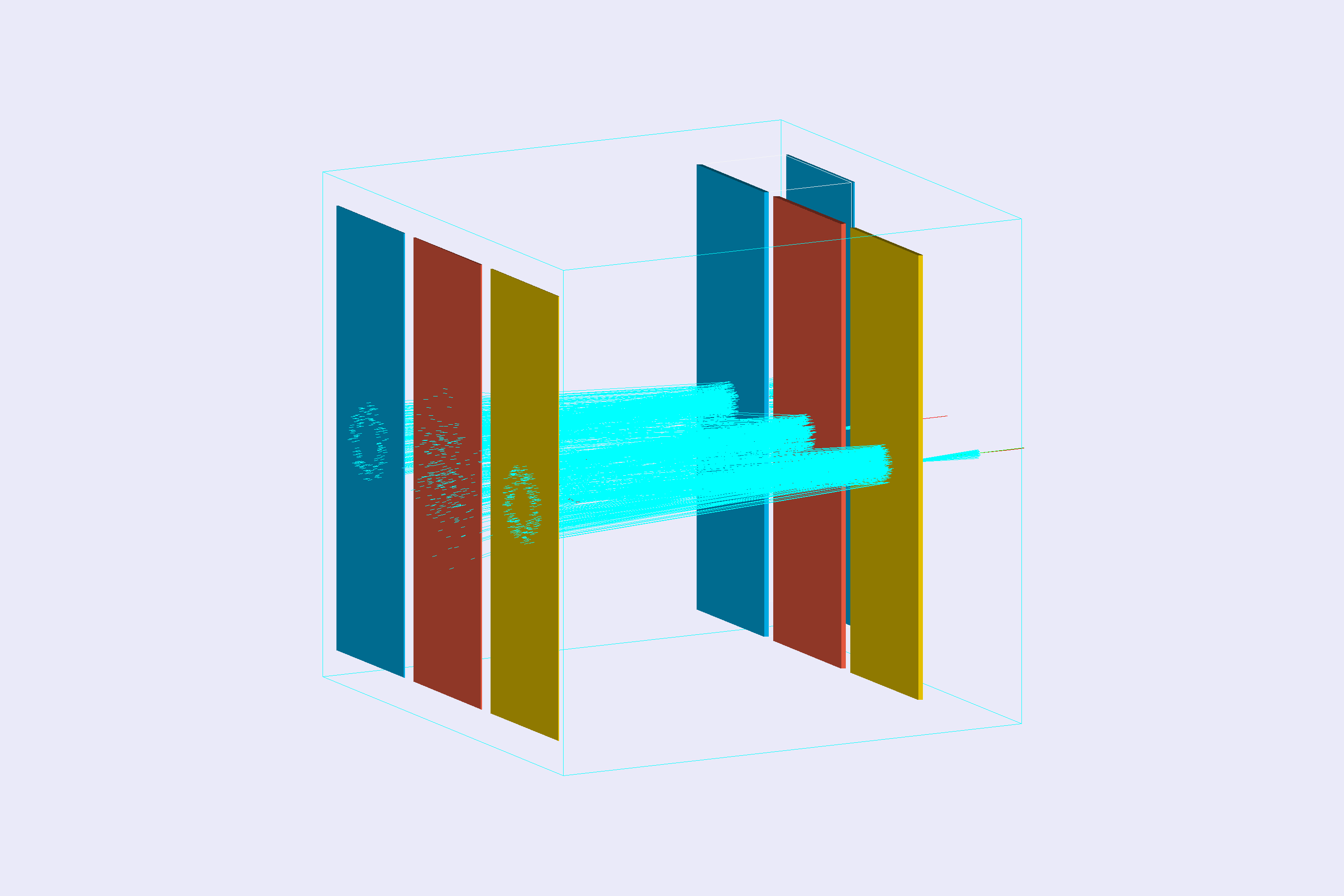
This example showcases the GEMC optical surfaces (“mirrors”). Three identical 1 GeV electrons cross a low-index gas radiator, each aimed at the center of one reflector plate. The Cherenkov photons stay in a narrow forward cone around each electron and land on that electron’s plate. Each plate demonstrates a different mirror definition:
- polished_metal -
dielectric_metal/polished/unifiedskin surface with an explicit reflectivity table: a typical metal-coated mirror; - rough_metal - the same skin surface with a
groundfinish: the reflection goes into a specular lobe (specularlobe = 1) whose blur is set by sigmaAlpha; - semi_transparent - a half-silvered mirror defined as a border surface between the radiator and its plate: 60% of the photons are reflected, 30% are transmitted through the plate (transmittance), and 10% are absorbed.
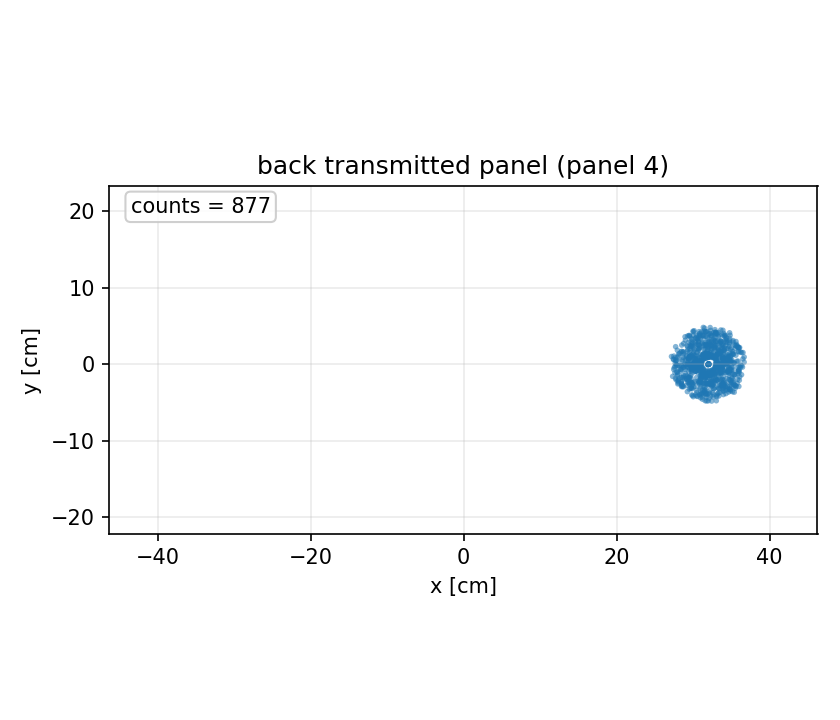
Each plate reflects its photons back onto its own upstream photon detector panel (using the gPhotonDetector digitization and drawn in its mirror’s color), so the panels see identical conditions and only the reflection differs. A fourth panel counts the transmitted photons after they cross a large gap behind the semi-transparent plate. Typical relative photon counts (flat panel = 1):
| Panel | Surface | Relative count |
|---|---|---|
| flat (gold) | polished, R = 0.90 | 1.00 |
| rough (tomato) | specular lobe, sigmaAlpha = 0.03 | about 0.99 (blurred image, slight leak) |
| semi (blue) | reflected, R = 0.60 | about 0.69 (= 0.60 / 0.90) |
| behind (blue) | transmitted, T = 0.30 | about 0.37 (= 0.30 / 0.90) |
Quickstart
Copy the example to your current directory. To create the geometry, run 10 events, and produce CSV output files:
cp -r $GEMC_HOME/examples/optical/mirrors .
cd mirrors
./mirrors.py
gemc mirrors.yaml -n=10
Geometry
The geometry is defined in mirrors.py. The world volume root contains a 1 m^3 gas radiator
(radiatorGas, a demonstration gas with refractive index about 1.001). Inside the radiator:
- three thin plates at mid-radiator: two aluminum plates carrying the skin mirrors, and the semi-transparent plate - made of radiator gas so that transmitted photons continue undisturbed - targeted by the semi_transparent border surface;
- three upstream photon detector panels, each aligned with one plate and drawn in its mirror’s color, collecting the photons reflected by that plate;
- a long transmission gap behind the semi-transparent plate, filled with an optical vacuum (refractive index 1) so the electron radiates no Cherenkov light in the gap and the transmitted photons can be seen crossing it;
- a fourth panel at the end of the gap, collecting the transmitted photons.
Interactive viewer:
Mirror definitions
Each mirror is a GMirror published alongside the geometry:
polished = GMirror("polished_metal")
polished.type = "dielectric_metal"
polished.finish = "polished"
polished.model = "unified"
polished.border = "SkinSurface"
polished.photonEnergy = "2.0*eV 3.0*eV 4.0*eV 5.0*eV 6.0*eV"
polished.reflectivity = "0.90 0.90 0.89 0.88 0.87"
polished.publish(cfg)
and volumes reference them by name:
plate.mirror = "polished_metal"
See the Mirrors documentation for the complete field reference.
Physics
The steering card enables optical physics:
phys_list: FTFP_BERT + G4OpticalPhysics
Running the example prints the surfaces created by GEMC:
G4World: created optical surface <mirrors/polished_metal> type <dielectric_metal>,
finish <polished>, model <unified>
G4World: created 3 optical surfaces, attached to 2 skin and 1 border logical surfaces
Plotting with the GEMC Analyzer
Run GEMC with 10 events first. The default YAML file writes the analyzer CSV streams.
gemc mirrors.yaml -n=10
Per-panel y vs x
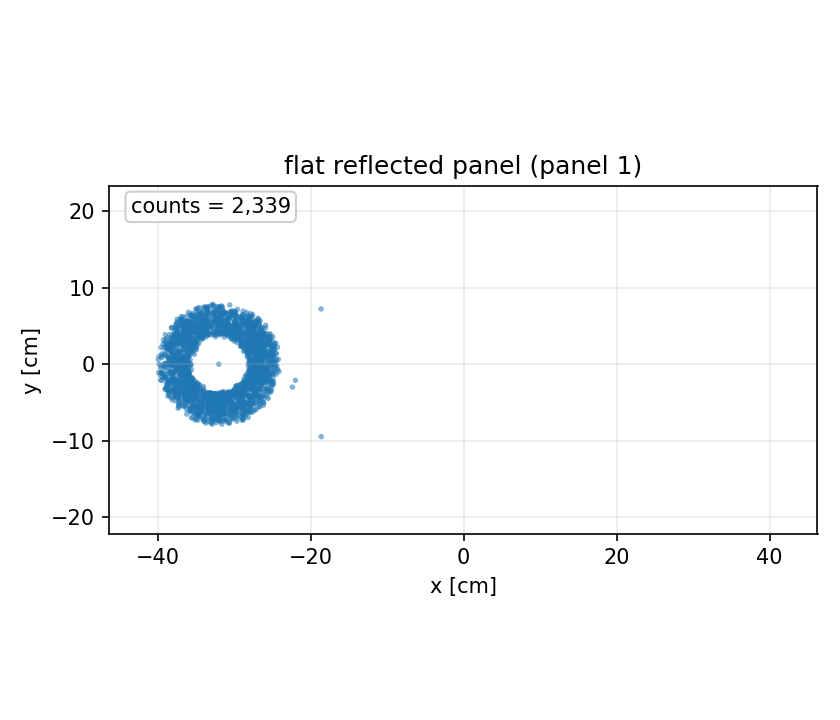
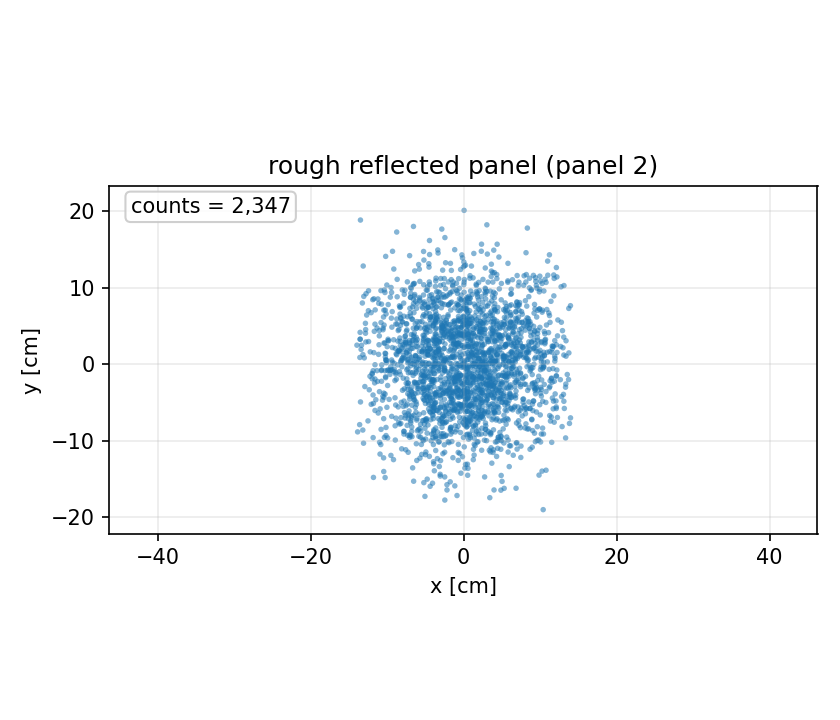
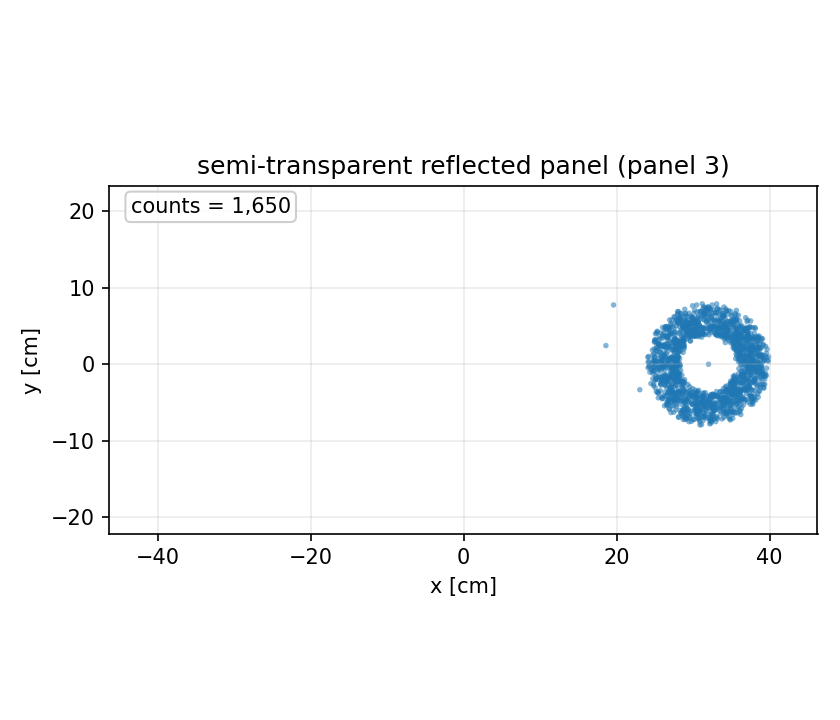
The plots below split the optical-photon hit positions by panel. The back transmitted panel is shown as its own plot, not merged into the semi-transparent reflected-panel plot. The count shown on each image is the number of rows selected from the true-information stream.
 |
 |
| flat reflected panel counts = 2,445 |
rough reflected panel counts = 2,269 |
 |
 |
| semi-transparent reflected panel counts = 1,681 |
back transmitted panel counts = 918 |